Christopher Nolan’s Hymn to Athena
Chris, what did you know?
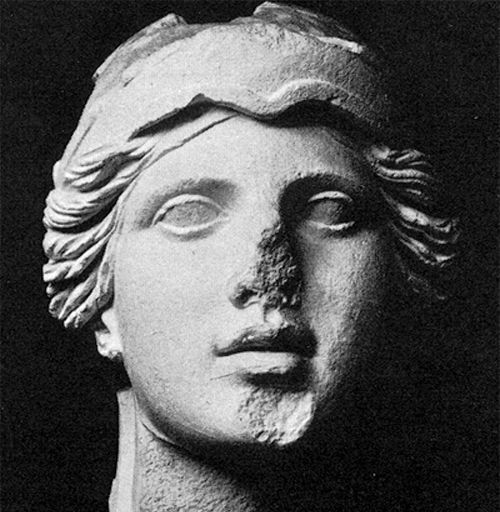
Image: Copy of the Athena Parthenos, ca. second century B.C. — “a rather free Hellenistic adaptation” of Pheidias’s lost original, erected in the Library of Pergamon. Pergamonmuseum, Berlin. Photograph from Center for Hellenic Studies, Harvard Library.
Christopher Nolan is known for his obsessive attention to detail and realism, but there’s a historical detail in The Odyssey that I can’t quite believe he intended.
The film includes two supporting actors, Tom Holland and Zendaya, who acknowledged in promotional interviews that they had been married in a private ceremony. (“When the interviewer asked Holland if he’d had to tell his family the photos were fake, he bluntly responded, ‘No, because they were all there.’”)
Zendaya plays an Athena who takes the form of an unnamed Trojan woman as Odysseus processes his role in the sack of Troy, while Holland plays a sidelined and militarily ineffectual Telemachus.
You might know Tom Holland better (I do) from his absolutely jaw-dropping viral performance on Comedy Central’s Lip Sync Battle in 2017, where he performed a drag routine to Rihanna’s “Umbrella” that had Zendaya — attempting to play his deadpan opponent in the battle — literally falling on the floor. Don’t stay here reading about obscure Homerica, go watch the performance; it’s one of the most committed performances, about anything, I’ve seen an actor do. You can see why she married him.
Here’s the thing: this clip also makes it totally appropriate that Nolan cast them as Telemachus and Athena. It’s actually canon that Athena once judged Telemachus in a … “dance contest,” I guess?
There’s not a ton about this online, but I pulled an article on it from Scan & Deliver. Apparently Homer has a hymn to Athena where she appears in the form of a judge for a dance:
Before them, nameless, one surpassing fair led off the song;
then sat she in the midst as judge, in silence and in reverence,
mantled beneath her veil, unmoving; nor did her heart
show forth its mind; and no man looking on her knew her. (25)
For she was Athena’s self, the child of aegis-bearing Zeus,
immortal though she was, in body likened to a woman. …
and out of the robes he [Telemachus!] stepped, his body like the immortals’.
He turned him here and there, leapt up on flashing feet;
and as a swallow, fleeing winter, darts through the bright air
in the season of the spring: so nimbly plied he his knees …
and shining out in beauty and in grace he blazed among them all.
And wonder seized on all who gazed about the dancing-floor;
but he, exulting, came before the throne. And in her heart
the grey-eyed one was glad, knowing him for the boy,
and out she laughed; to earth there fell her shining veils;
immortal as she was, she stood revealed among them all.
The book is from 1921, so I can put the whole chapter online. That counts as a dance battle, right? See what you think, but I think it fits.
One nice detail is, not only did this happen with Athena and Telemachus, it probably traces back to a real event in the oral period before Homer. Harrower, who translated the poem, writes, “somewhere behind the custom there is a first time, an evening when the thing was not yet a custom but an event; and it seems to me that this poem remembers its evening.” She infers from a close reading:
There was a contest of dancing at a festival of Athena,
and the two performers who mattered were already, be-
fore either moved, the two most gazed-upon persons of
their little world — paired by the public gossip long be-
fore they were paired in fact, as such persons always are.
The woman danced first. She was the finer dancer, and
knew it, and I suspect she danced that night in some de-
liberate plainness, even — if the Hybristika’s two-way
exchange may guide us — in a young man’s gear, as the
boys would dance in the women’s; the rite’s symmetry ar-
gues it, and it would explain why the tradition, which for-
gets her name, remembers her authority: having shown
what the standard was, she sat down veiled in the midst
to judge by it.
[135]The essence of the evening was that nobody had
known the boy could dance. He had been at pains, I
think, that nobody should — the poem’s own word is
κρύβδην, and a skill so carefully hidden is a skill being
saved for something. He entered among the girls, in-
distinguishable; and when his turn came he began in
the old manner, softly, charmingly, a shade quaintly
— the very image of the decorous tradition he was one
minute from overthrowing. Then the garments went one
way and the boy another; and what followed was not a
maiden’s measure but a virtuosity with no name yet in
that place, spent — this is the detail I trust most — not
upon the crowd but upon one spectator. He carried the
dance to the foot of her seat. The performance had one
audience; the rest were witnesses. And the composure
which it was the whole design of the evening to break,
broke. The tradition’s one unimpeachable fact about her
is that she laughed; the veil that falls in the poem falls,
I take it, for the sensation of that laughter — and I take
leave to believe she came off her seat entirely.
(My emphasis.) And then she explains how events like this — between local “celebrities”? — find their way into canon:
Such an evening would be told before it was ever sung.
It would be told by everyone who stood there and then by
everyone who wished they had; the telling would wear
away every circumstance except the ones that mattered
— the disguise, the laughter, the rain — until what re-
mained was already very nearly a hymn, wanting only
metre. A village would keep it as villages keep such
things, in a dance done yearly and a story told over it.
And at the last, centuries on [she puts it in the fifth
century AD], a bookish and devout man,
whose Homer was a scripture and whose theatre was
the pantomime — an art whose masters were expected
to be both sexes in one evening, whose contests were
judged from thrones, and whose partisans could empty
a city’s patience faster than a war — set the old local
tale in the only Greek he loved. When he imagined a
dancing-contest judged from a seat of honour, with an
adored performer and a house struck mad, he was not
imagining the bronze age. He was imagining what he
had seen; late poets always do; it is how we date them.
I ended up really curious about Harrower herself, and what else she got up to after 1921. This part at the end seems fascinating. “I said above that I could name perhaps three men now living with Greek enough to have made this poem” (if it was some nineteenth-century fraud rather than the original she suspected), and —
that each of the three would sooner have signed it. I
have been asked — I have asked myself — whether there
is not a fourth account which I declined to number: that
the hymn was made by someone for whom signature was
not among the possibilities; some scholar, let us say, to
whom the age offers the reading of other men’s proofs
and the thanks of other men’s prefaces; who, having
written a poem about a performer nobody suspected —
about a triumph achieved in borrowed dress and pro-
nounced sound work by the very authority it deceived —
might have felt that to send it into the world unclaimed,
and let the learned judge it as they judged the dancer,
was not a fraud upon the tradition but an obedience to
the poem.
Chris Nolan, if you’re out there, tell me if you’re the other person who read this, or if it’s all some beautiful coincidence. I love the layers of history and myth either way.
Author’s note. This note changes how the essay reads. It can be revealed on the web version of this essay with JavaScript enabled.
Get new writing by email: